

Vancouver laneway house | BCBusiness
Brendon Purdy and Akua Schatz found the only way to afford west side living was to go small.
They’re tiny and adorable, but do Vancouver’s laneway houses make economic sense?
In the early fall of 2009, Akua Schatz, 33, and her husband Brendon Purdy, 34, faced a trifecta of choices. Having lived for three years in Brendon’s parents’ basement in Vancouver’s Dunbar neighbourhood, they wanted a place of their own. For $400,000 they could get a nice three-bedroom home in suburban Abbotsford and face a gruelling two-and-a-half-hour daily commute. Or they could get a compact highrise condo in Yaletown and live in the air. Or, given Vancouver’s then-new legislation allowing laneway housing, they could arrange that their own miniature house be built in Brendon’s parents’ backyard. Today, beer in hand, the two sit on the outdoor deck of their 500-square-foot laneway home off West 23rd Ave., pleased by the fact the project is finished and that, at $280,000, their modernist, one-bedroom Dunbar bungalow cost a fraction of the other, much larger homes in the neighbourhood.
They are not alone. From Maple Ridge to Montreal, from Surrey to San Francisco, municipalities have begun to realize that single-family residential neighbourhoods can be densified without being destroyed, and that increasing density mitigates the calamitous environmental and economic effects of suburban sprawl. Since the 2009 launch of Vancouver’s EcoDensity laneway housing initiative, more than 200 little homes have either been built or are currently nearing completion in the city. These range from 500 square feet to 750 square feet, and as public interest has grown, the city’s building permit department is now processing between 30 and 40 new laneway housing applications each month.
No one knows more about the politics and practicalities of laneway housing than Vancouver’s director of city planning, Brent Toderian. He set the program in motion in 2006, and sees it today as his baby. Faced with a city hemmed in by its mountains and water, planners’ traditional logic would have suggested there were just two options for increasing density in the fast-growing region: Vancouver could grow upward in highrises, or outward in Los Angeles-style suburbs. But both required deep-pocketed developers, and both presented troubling aesthetic and environmental problems. A third option did exist, one Toderian believed had never been tried on a major metropolitan, city-wide basis: small, backyard, laneway homes. Because Vancouver has lanes everywhere and because the initiative covers most of the city, Vancouver is, Toderian believes, unique in the scope of its proposed lane housing. He believes Vancouver’s lane housing initiative is unparalleled in North America, and probably will be, when completed, one of the largest urban infill projects in the world.
Two years ago, Vancouver city council approved a wide-ranging laneway program that allows for the placing of a very small residential building on virtually every 33-foot (or larger), lane-facing, detached housing lot in Vancouver. This covers 90 per cent of the city’s entire housing stock. In other words, an estimated 70,000 Vancouver homeowners can, following strict development guidelines, add a laneway home to their RS-1 or RS-5 residential-zoned property.
Says Toderian today, “Lane housing is about ordinary people. Thousands of individual homeowners can do it, one by one by one. It’s publicly propelled, not corporate-propelled densification. It’s gradual. It’s discrete. It’s green.” He expects there’ll be thousands of Vancouver lane houses built in the decades ahead. Several other nearby municipalities, including the City of North Vancouver, Coquitlam and Maple Ridge, have followed Vancouver’s lead.
Agnes and Manuel Mendoza, Filipino immigrants in their early 60s, are owners of a garden-engulfed bungalow at the corner of McGill and Slocan streets, not far from the PNE. In the fall of 2009, they learned about Vancouver’s new policy on back-alley housing, and Lanefab Design Build Ltd.’s intention to work with clients considering building laneway homes. Agnes checked out the city’s new building regulations, Lanefab’s projected costs for a 710-square-foot unit, and realtors’ estimates of monthly rental income from a miniature, one-and-a-half-storey east Vancouver lane house. The math made sense.
The Mendozas left the architectural work, the bureaucratic jockeying and the construction to Lanefab, which had been set up a few months earlier to capitalize on Vancouver’s impending laneway program. As Lanefab’s co-owner Bryn Davidson explains, once the lane house foundations are in, the prefab building is delivered on two flatbed trucks, then erected and insulated in two days. From start to finish, construction takes four months. Says Davidson, “Banks view lane houses favourably. They’re a way of converting equity – your primary home – into cash flow. That was the Mendozas’ thinking.”
[pagebreak]
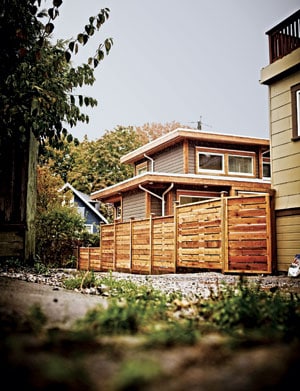
Image: Adam Blasberg
Schatz and Purdy’s 500-square-foot home blends in
with its Dunbar surroundings.
From their own deck, the Mendozas can now glimpse, beyond their backyard’s new bamboo hedge, the flat-roofed, one-bedroom house that resulted, and they happily talk about the financial considerations that led to its construction. “In terms of an investment . . . if you build that for $220,000,” says Manuel, pointing, “and you rent it for $1,700 a month, it’s a no-brainer. Whatever your mortgage, you’ll be ahead.” Even with a $150,000 increase in their property’s assessed value, and a subsequent increase in property tax, plus maintenance costs and higher insurance and utility costs for the two houses, the Mendozas believe they’ll benefit from the cash flow as long as the laneway house is rented. Their young tenants, a professional couple who’d grown tired of apartment life, are just visible on their sunlit, west-facing balcony nearby. For the same rent they’d pay for aerial highrise life downtown, they have their own little house and garden.
The Mendozas report that their east Vancouver neighbours have all been curious, stopping to ask about the lane house’s design process, the permit protocols at city hall and the building’s earning potential. Everyone has, not surprisingly, wanted a peek inside. It is, in fact, the very first laneway house completed and occupied in Vancouver. And no one has complained. Most of the Mendozas’ neighbours, like themselves, have immigrant Asian or European roots and understand that living close is an inevitable part of urban life.
Laneway house critics
There are, of course, critics of Vancouver’s laneway housing. None are more vocal than the Dunbar Residents’ Association, and its spokesperson, 65-year-old retired architect Peter Selner. The DRA feels that neighbourhoods should have had a say in whether lane houses were permitted in their district, and that no such consultation took place. They’re also leery of the privacy intrusions laneway structures inevitably make upon those living nearby. They’re especially worried that the three side-by-side, over-height lane homes built in the 4600-block of Point Grey’s West 11th Avenue might be duplicated in their adjacent neighbourhood. But as the months have passed, criticism has subsided as laneway regulations have been tightened. In fact, the city has imposed a strict one-and-a-half-storey height-limit on buildings.
While the Mendozas built on their own property for rental purposes and the Schatz/Purdy couple built for themselves in their family’s backyard, a third laneway option exists for private developers like Vancouver’s John Kyriazis, age 55. His latest project is a nearly completed 3,000-square-foot rental house and its adjacent two-bedroom rental lane house on a 33-foot corner lot on Triumph Street in east Vancouver. This simultaneous construction of two new houses on a single lot occurs in over half of all laneway projects to date. “It’s cheaper to do two at the same time,” says Kyriazis. “It costs $15,000 to bring new sewers and gas to the lot’s property line, whether it’s one or two houses. Landscaping’s cheaper. Construction’s cheaper.” Hammers bang and cupboards are being installed around him as he discusses the $550,000 construction project with Vancouver realtor James Wong.
The two run through the financial calculations. If Kyriazis chooses to live in the lane house, the two rental units in the main building should produce around $52,000 a year in revenue. With his monthly mortgage payments, plus insurance, taxes and other expenses, Kyriazis figures he’ll still be up over $10,000 a year in rental revenue. He calls this his “retirement income.” The trick of the math is this: when you build a laneway house on a single-family lot, the land for the lane house is, ostensibly, free. Both men admit they’ve faced the annoying fact that many banks have yet to catch on to the equity considerations and the economic benefits that lane homes bring to investors. Vancity, they agree, is a leader in promoting the social and financial advantages of putting two houses where once there was only one.
Vancity has what it calls its Laneway Homebuyers’ Bundle, which is meant to encourage the development of lane homes. As the credit union sees it, these small backyard buildings will increase the amount of affordable housing in Vancouver without ghettoizing the elderly, or low-income workers or those who don’t like highrise living. They’ll also help keep families together, with aging parents and children choosing to live side by side. As Colin Lawrence, mortgage development manager and point man for Vancity’s laneway program, explains, “Many of these laneway houses start as rental properties. Typically, that’s $1,200 to $1,700 a month for one bedroom; $1,400 to $2,400 for two bedrooms. Depending on equity (usually the primary house), the down payment and type of mortgage plan, the monthly payment on a $200,000 laneway loan is around $720 to $900. So the figures work. But . . . the purpose of these houses can evolve. They can be converted into space for, say, an elderly parent. Or space for university-age kids. Then, maybe, rental income drops.”
[pagebreak]
Financial considerations of a laneway house
There are, however, other financial considerations that laneway housing investors need to consider, says Vancouver’s Sam Wyatt, a realtor with Re/Max Real Estate Services. He likes the concept of infill densification and how it benefits the city, but points out that the typical $250-per-square-foot cost for a new standard house on Vancouver’s west side often nearly doubles for a little lane house. This is because expensive-to-install services like electricity, sewage, sprinklers and heating are required, regardless of the structure’s size. “The building’s footprint is smaller,” says Wyatt, “but the costs are larger.”
Laneway Housing Facts
• The average square-footage of North American homes has more than doubled in the past 36 years: from 1,075 square feet in 1975 to 2,438 square feet today.
• Since Vancouver introduced lane housing in 2009, more than 200 have either been built or are currently nearing completion. The city’s building permit department is now processing between 30 and 40 new laneway housing applications a month.
• There can be no strata-titling or sale of the laneway house; the property cannot be subdivided.
• Most lane houses are one and a half storeys high and contain a garage.
• Sixty-seven per cent have one bedroom; 28 per cent have two; five per cent are studios.
• Laneway houses are scattered evenly across the east and west sides of the city.
• The typical cost to build a laneway house ranges from $225,000 to $350,000, including between $15,000 and $30,000 for development permits, utilities installation and landscaping.
• A Google search will turn up nine companies and many more general contractors building these little houses in Vancouver.
• The structures go by various names, including grannie flats, laneway houses, garden homes and coach houses. Vancouver’s director of city planning, Brent Toderian, jokingly suggests the label “Fonzie suites,” to honour TV’s popular Happy Days character, The Fonz, who was a renter.
Then there’s a second troublesome consideration, Wyatt believes, for those seeking a good rental cash flow. With a lane house often costing more than expected, that new mortgage, combined with the main house’s continuing mortgage, can erase most monthly rental income. Yes, a rental lane house will, in time, add significant resale value to the property and will, in the long term, bring in revenue. But it may not be an immediate cash cow. “For homeowners,” Wyatt warns, “you need to do the math. Is the lane house for family, or for rental? If it’s for rental, investors need to see if the new mortgage payment, the tax increases and the cash flow all work.” These revenue issues, Wyatt adds, don’t apply to families who invest in a lane house for an elderly parent, a non-rental caretaker or university-age children.
The potential for a laneway home’s usage to evolve over time is one of the things that appealed to 63-year-old Elizabeth Ball. She sat on Vancouver City Council in 2006 when she first heard a presentation from Smallworks Studios and Laneway Housing Inc. about the feasibility of laneway housing as part of Vancouver’s proposed EcoDensity program. She liked the idea then, she says, and sitting today with her husband, Douglas Welch, 60, in their one-year-old, $300,000 South Cambie lane house, she likes the idea a lot more now. The initial plan was for the little house to provide Ball’s ailing father with proximity to his family. That didn’t happen, but in the intervening time the two-bedroom, craftsman bungalow has accommodated visiting Dutch friends and Ball’s sister. And someday soon, probably, it will accommodate the couple’s two children. “One of the nice things about this,” says Ball, gesturing around the cozy living room, “is it allows flexibility. It’s for family now. But later, we may move in here ourselves, using it as a base, and rent the main house out while we go travelling. For older couples, it provides choices.”
Smallworks owner Jake Fry, 48, has built 16 lane houses in Vancouver – mostly on Vancouver’s west side, including the Ball/Welch house. He has 24 more on order. He has lived in a 900-square-foot duplex for years, he reports, and believes in the ethics of small. It’s not simply because the average west side density today is 2.1 people per lot (while 50 years ago it was 4.5) or that the demographic is aging. Without increasing the number of people in the area, he says, and especially young people, neighbourhood businesses suffer, schools close, and inevitably, infrastructure and transit costs rise. This is the fundamental problem of suburbs: insufficient density to sustain quality public services. “In the future,” says Fry, “austerity and modesty will become a necessity. The conventional wisdom is more is better, bigger is better. But we’re impoverishing our affluence. If you live more modestly, you liberate yourself from the traditional big home. That’s good for the environment. It preserves neighbourhoods. It makes life more enjoyable.”
This is something Akua Schatz and Brendon Purdy know a lot about. Since they moved into their compact Dunbar lane house this past July, they’ve discovered the realities of small. They admit that downsizing from their 900-square-foot basement suite to their 500-square-foot lane house has been an adjustment. But it is theirs in a way most laneway houses, which are usually sold on a turnkey arrangement, aren’t. Despite being amateurs at carpentry, once Smallworks’ prefab building envelope was erected, Schatz and Purdy did a lot of the interior work, including floors, tiling and doorways, themselves. (Purdy has created a time-lapse video, which can be found online by Googling “akua and brendon build small.”) It was a labour of love. Moreover, in a legal arrangement with Purdy’s family, the young couple acquired ownership of the lane house (with a loan co-signed by the parents), while the parents retained possession of the land (as stipulated by Vancouver’s Laneway Housing regulations).
They have, out of necessity, had to simplify. Among many other things, gone are books from undergraduate days. Says Purdy, “This is a reality check. What do you really need? What space is unnecessary? What stuff’s unnecessary? The larger the house, the more you end up shrinking into it. In urban Japan or Europe, people live in small spaces and go out more.” In the building’s design, the couple have made sure certain things have been included to minimize feelings of being cramped, including a bathtub, lots of closets and windows, a large and efficient kitchen and a roof patio.
They’ve also learned the lane house connects them to the outside more. Back-alley dog-walkers have become friends. They eat out more. They bicycle more. In fact, the basement crawl space beneath their kitchen contains seven bicycles that take them all over the city. They do not own a car. “If we run out of milk,” says Schatz, with a wave toward her in-laws’ house across the backyard, “or if they run out of eggs, or if we need to borrow a car . . . ” She lets the gesture finish the sentence. And on Sunday evenings, one family cooks and the other brings the wine, as the two generations re-explore the old, and often forgotten, virtues of sharing and closeness.